February 03, 2026
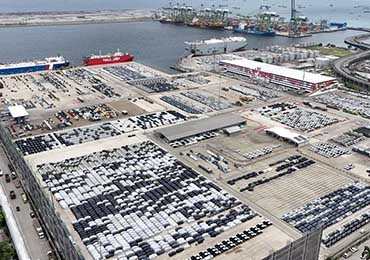
Jakarta, February 3, 2026 – PT Indonesia Kendaraan Terminal Tbk (IDX: IPCC), the operator of the Vehicle Terminal under the management of the Pelindo Multi Terminal (SPMT) Subholding, has once again demonstrated its reliability by simultaneously serving international vessels at the IPCC Jakarta Branch. The two mother vessels (MVs) are the MV Glovis Clipper with a length of 200 meters, a width of 32.3 meters, and a maximum capacity of 6,500 CBU units, and the MV Kariyushi Leader (NYK Line) with a length of 179 meters, a width of 32.2 meters, and a maximum capacity of 5,000 CBU units. This underscores IPCC's readiness to manage berthing windows and unlock berth capacity by optimizing the IPCC docks to facilitate logistics flows.
It was recorded that MV Glovis Clipper originating from Casablanca, Morocco docked first on February 2, 2026 with a cargo load plan of 2,308 CBU units for export with a departure plan from the IPCC dock on February 3. MV Kariyushi Leader docked on February 3, 2026 from Laem Chabang, Thailand with detailed unloading manifests of 1 heavy equipment cargo and general cargo each, while for cargo loading/export as many as 2,519 cargo units consisting of 2,510 CBU units, and 9 heavy equipment units planned to depart from Wednesday, February 4, 2026 from the IPCC dock. This shows IPCC's superiority in providing reliable operational services where it can complete the loading and unloading of cargo on both MVs in just 1x24 hours. IPCC operational services are supported by prioritizing the safety, security, and reliability aspects of the IPCC operational team and also by collaboration between IPCC and stakeholders in the port area, especially Customs and Excise and KSOP to optimize berthing outside the area.
IPCC's success in simultaneously berthing two vessels is inseparable from the use of a digital-based terminal operational system (PTOS-C) to ensure punctuality, service accuracy, and cargo security in real time. Furthermore, the berthing of two vessels with large characteristics and cargo volumes simultaneously reflects the readiness of IPCC's infrastructure and the competence of human resources in managing the operational complexity of the vehicle terminal to maintain the smooth flow of internal terminal traffic, minimize potential operational bottlenecks, and shorten port stays.
IPCC management emphasized that the implementation of Unlocking Berth Capacity is not only oriented towards increasing physical capacity, but also on strengthening systems, procedures, and synergies with stakeholders, including KSOP, Customs, and business partners. "IPCC is committed to encouraging the implementation of service excellence with the campaign "zero defect, zero accident and safety starts with me" in the workplace and implementing a sustainable company both from an operational and human resource perspective that is oriented towards green and smart ports," said Bagus Dwipoyono, Director of Operations and Engineering IPCC.
Through this approach, the IPCC strives to provide sustainable added value for service users while supporting the smooth operation of the national automotive industry supply chain. Going forward, the IPCC will continue to encourage service innovation and optimize terminal assets to address the dynamic demand for vehicle logistics, both for domestic and international markets. This step aligns with the IPCC's commitment as part of the Pelindo Multi Terminal subholding to strengthen Indonesia's role as a maritime gateway and vehicle distribution center in the region.
IPCC-IntegratedAutoSolutions
IPCC, Leading to be The World Class Car Terminal Ecosystem
#IPCCTerminalKendaraan #IPCCIntegratedAutoSolutions
#PelindoGroup #IndonesiaMaritimeGateway
-- end --